
100 ready-to-use Claude prompts in 10 sections — learning, productivity, career, coding, content, business, research, writing, health and money. Copy any prompt and start creating in seconds.
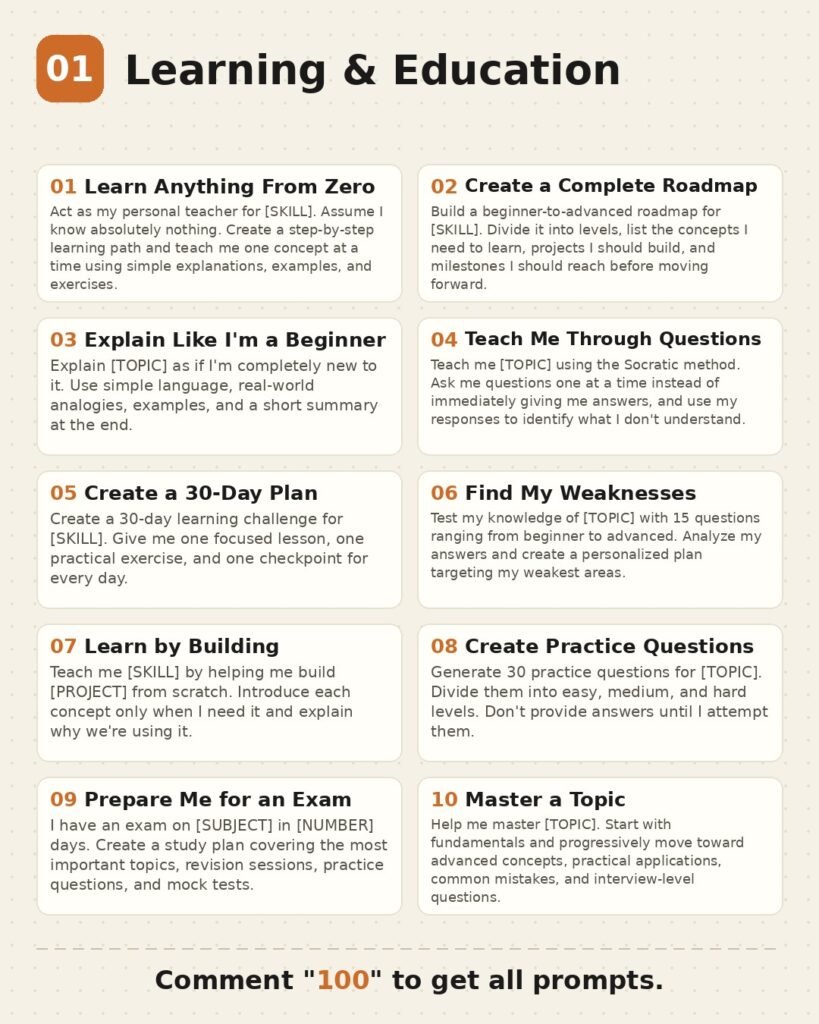
Learning & Education
01. Learn Anything From Zero — Act as my personal teacher for [SKILL]. Assume I know absolutely nothing. Create a step-by-step learning path and teach me one concept at a time using simple explanations, examples, and exercises.
02. Create a Complete Roadmap — Build a beginner-to-advanced roadmap for [SKILL]. Divide it into levels, list the concepts I need to learn, projects I should build, and milestones I should reach before moving forward.
03. Explain Like I'm a Beginner — Explain [TOPIC] as if I'm completely new to it. Use simple language, real-world analogies, examples, and a short summary at the end.
04. Teach Me Through Questions — Teach me [TOPIC] using the Socratic method. Ask me questions one at a time instead of immediately giving me answers, and use my responses to identify what I don't understand.
05. Create a 30-Day Plan — Create a 30-day learning challenge for [SKILL]. Give me one focused lesson, one practical exercise, and one checkpoint for every day.
06. Find My Weaknesses — Test my knowledge of [TOPIC] with 15 questions ranging from beginner to advanced. Analyze my answers and create a personalized plan targeting my weakest areas.
07. Learn by Building — Teach me [SKILL] by helping me build [PROJECT] from scratch. Introduce each concept only when I need it and explain why we're using it.
08. Create Practice Questions — Generate 30 practice questions for [TOPIC]. Divide them into easy, medium, and hard levels. Don't provide answers until I attempt them.
09. Prepare Me for an Exam — I have an exam on [SUBJECT] in [NUMBER] days. Create a study plan covering the most important topics, revision sessions, practice questions, and mock tests.
10. Master a Topic — Help me master [TOPIC]. Start with fundamentals and progressively move toward advanced concepts, practical applications, common mistakes, and interview-level questions.

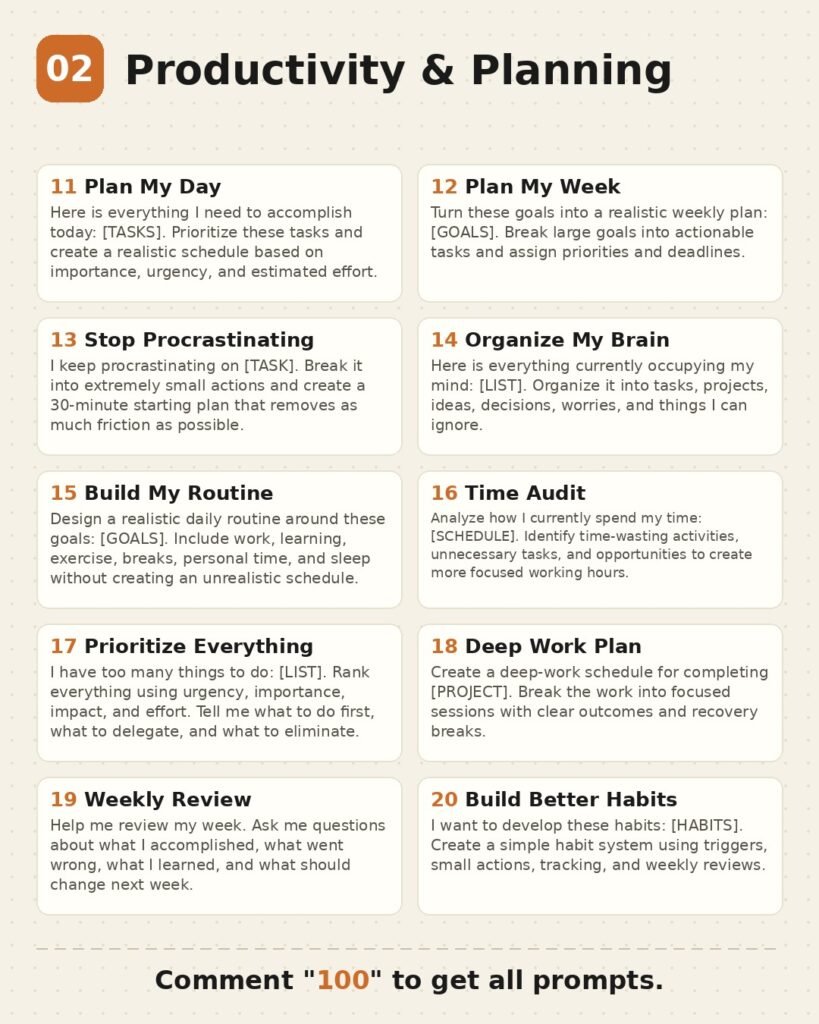
Productivity & Planning
11. Plan My Day — Here is everything I need to accomplish today: [TASKS]. Prioritize these tasks and create a realistic schedule based on importance, urgency, and estimated effort.
12. Plan My Week — Turn these goals into a realistic weekly plan: [GOALS]. Break large goals into actionable tasks and assign priorities and deadlines.
13. Stop Procrastinating — I keep procrastinating on [TASK]. Break it into extremely small actions and create a 30-minute starting plan that removes as much friction as possible.
14. Organize My Brain — Here is everything currently occupying my mind: [LIST]. Organize it into tasks, projects, ideas, decisions, worries, and things I can ignore.
15. Build My Routine — Design a realistic daily routine around these goals: [GOALS]. Include work, learning, exercise, breaks, personal time, and sleep without creating an unrealistic schedule.
16. Time Audit — Analyze how I currently spend my time: [SCHEDULE]. Identify time-wasting activities, unnecessary tasks, and opportunities to create more focused working hours.
17. Prioritize Everything — I have too many things to do: [LIST]. Rank everything using urgency, importance, impact, and effort. Tell me what to do first, what to delegate, and what to eliminate.
18. Deep Work Plan — Create a deep-work schedule for completing [PROJECT]. Break the work into focused sessions with clear outcomes and recovery breaks.
19. Weekly Review — Help me review my week. Ask me questions about what I accomplished, what went wrong, what I learned, and what should change next week.
20. Build Better Habits — I want to develop these habits: [HABITS]. Create a simple habit system using triggers, small actions, tracking, and weekly reviews.

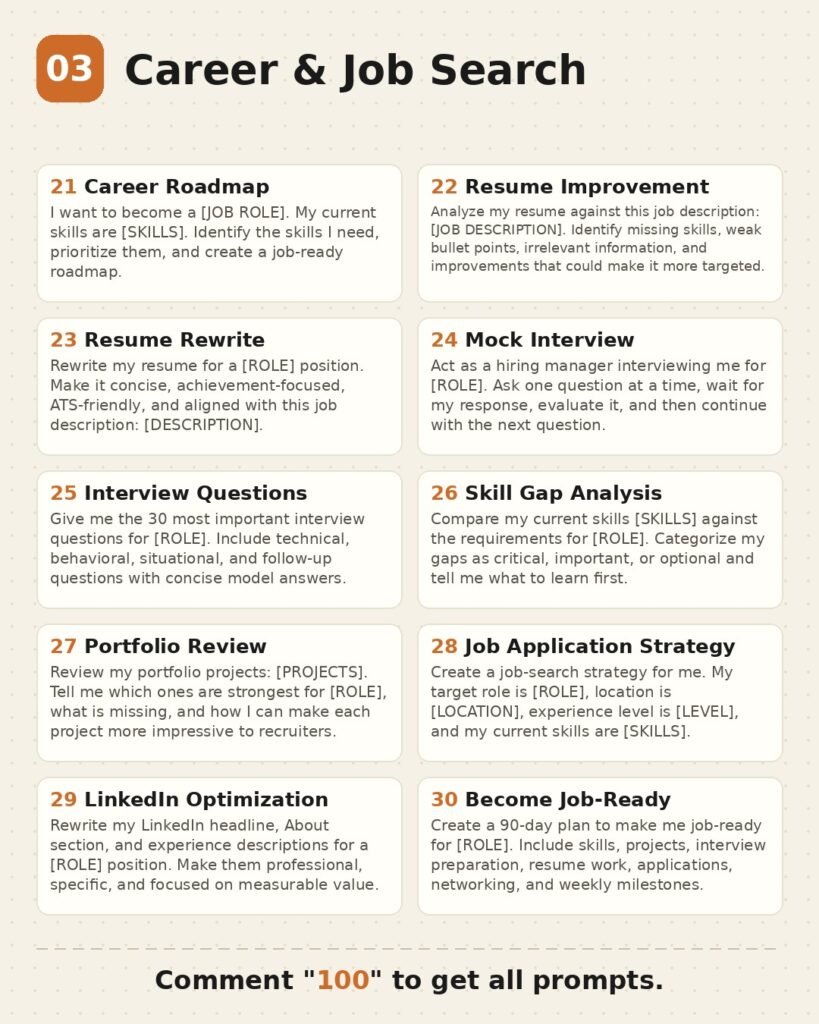
Career & Job Search
21. Career Roadmap — I want to become a [JOB ROLE]. My current skills are [SKILLS]. Identify the skills I need, prioritize them, and create a job-ready roadmap.
22. Resume Improvement — Analyze my resume against this job description: [JOB DESCRIPTION]. Identify missing skills, weak bullet points, irrelevant information, and improvements that could make it more targeted.
23. Resume Rewrite — Rewrite my resume for a [ROLE] position. Make it concise, achievement-focused, ATS-friendly, and aligned with this job description: [DESCRIPTION].
24. Mock Interview — Act as a hiring manager interviewing me for [ROLE]. Ask one question at a time, wait for my response, evaluate it, and then continue with the next question.
25. Interview Questions — Give me the 30 most important interview questions for [ROLE]. Include technical, behavioral, situational, and follow-up questions with concise model answers.
26. Skill Gap Analysis — Compare my current skills [SKILLS] against the requirements for [ROLE]. Categorize my gaps as critical, important, or optional and tell me what to learn first.
27. Portfolio Review — Review my portfolio projects: [PROJECTS]. Tell me which ones are strongest for [ROLE], what is missing, and how I can make each project more impressive to recruiters.
28. Job Application Strategy — Create a job-search strategy for me. My target role is [ROLE], location is [LOCATION], experience level is [LEVEL], and my current skills are [SKILLS].
29. LinkedIn Optimization — Rewrite my LinkedIn headline, About section, and experience descriptions for a [ROLE] position. Make them professional, specific, and focused on measurable value.
30. Become Job-Ready — Create a 90-day plan to make me job-ready for [ROLE]. Include skills, projects, interview preparation, resume work, applications, networking, and weekly milestones.

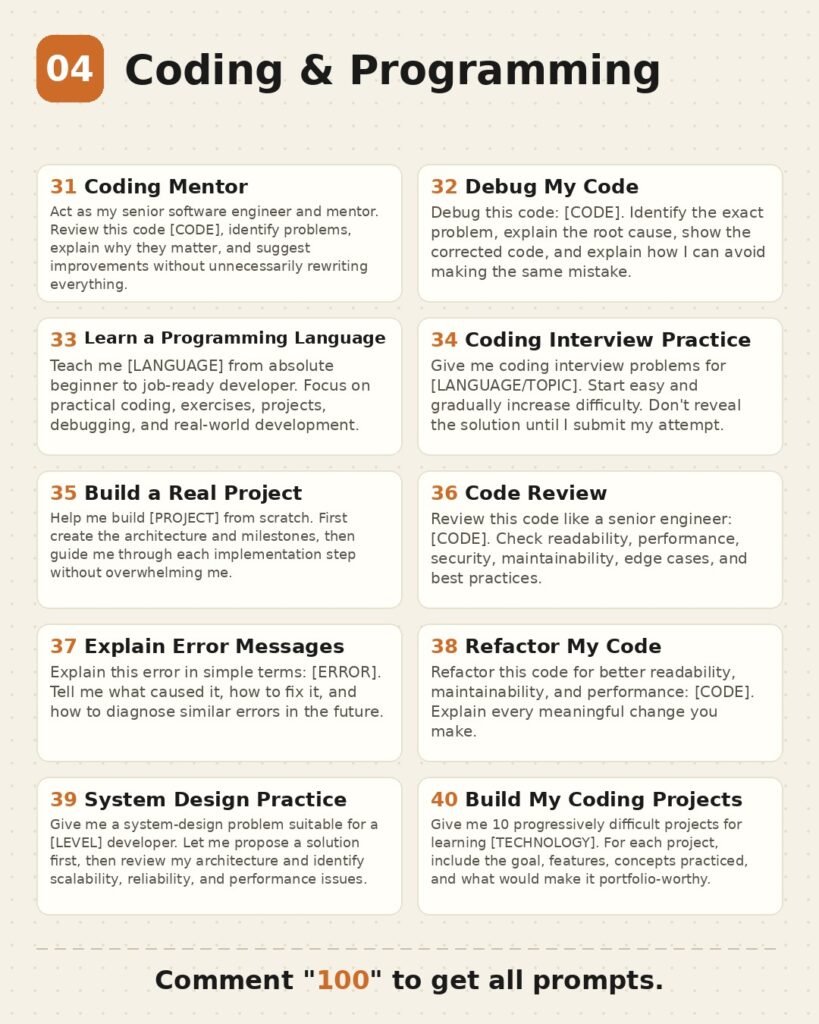
Coding & Programming
31. Coding Mentor — Act as my senior software engineer and mentor. Review this code [CODE], identify problems, explain why they matter, and suggest improvements without unnecessarily rewriting everything.
32. Debug My Code — Debug this code: [CODE]. Identify the exact problem, explain the root cause, show the corrected code, and explain how I can avoid making the same mistake.
33. Learn a Programming Language — Teach me [LANGUAGE] from absolute beginner to job-ready developer. Focus on practical coding, exercises, projects, debugging, and real-world development.
34. Coding Interview Practice — Give me coding interview problems for [LANGUAGE/TOPIC]. Start easy and gradually increase difficulty. Don't reveal the solution until I submit my attempt.
35. Build a Real Project — Help me build [PROJECT] from scratch. First create the architecture and milestones, then guide me through each implementation step without overwhelming me.
36. Code Review — Review this code like a senior engineer: [CODE]. Check readability, performance, security, maintainability, edge cases, and best practices.
37. Explain Error Messages — Explain this error in simple terms: [ERROR]. Tell me what caused it, how to fix it, and how to diagnose similar errors in the future.
38. Refactor My Code — Refactor this code for better readability, maintainability, and performance: [CODE]. Explain every meaningful change you make.
39. System Design Practice — Give me a system-design problem suitable for a [LEVEL] developer. Let me propose a solution first, then review my architecture and identify scalability, reliability, and performance issues.
40. Build My Coding Projects — Give me 10 progressively difficult projects for learning [TECHNOLOGY]. For each project, include the goal, features, concepts practiced, and what would make it portfolio-worthy.

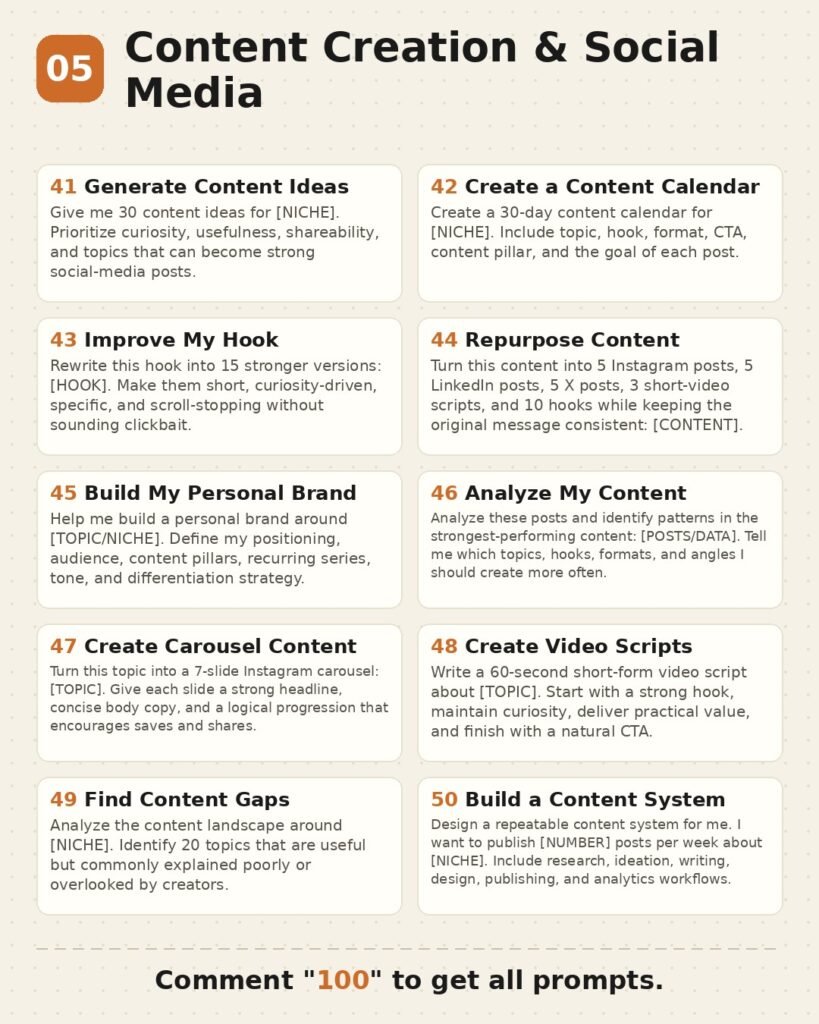
Content Creation & Social Media
41. Generate Content Ideas — Give me 30 content ideas for [NICHE]. Prioritize curiosity, usefulness, shareability, and topics that can become strong social-media posts.
42. Create a Content Calendar — Create a 30-day content calendar for [NICHE]. Include topic, hook, format, CTA, content pillar, and the goal of each post.
43. Improve My Hook — Rewrite this hook into 15 stronger versions: [HOOK]. Make them short, curiosity-driven, specific, and scroll-stopping without sounding clickbait.
44. Repurpose Content — Turn this content into 5 Instagram posts, 5 LinkedIn posts, 5 X posts, 3 short-video scripts, and 10 hooks while keeping the original message consistent: [CONTENT].
45. Build My Personal Brand — Help me build a personal brand around [TOPIC/NICHE]. Define my positioning, audience, content pillars, recurring series, tone, and differentiation strategy.
46. Analyze My Content — Analyze these posts and identify patterns in the strongest-performing content: [POSTS/DATA]. Tell me which topics, hooks, formats, and angles I should create more often.
47. Create Carousel Content — Turn this topic into a 7-slide Instagram carousel: [TOPIC]. Give each slide a strong headline, concise body copy, and a logical progression that encourages saves and shares.
48. Create Video Scripts — Write a 60-second short-form video script about [TOPIC]. Start with a strong hook, maintain curiosity, deliver practical value, and finish with a natural CTA.
49. Find Content Gaps — Analyze the content landscape around [NICHE]. Identify 20 topics that are useful but commonly explained poorly or overlooked by creators.
50. Build a Content System — Design a repeatable content system for me. I want to publish [NUMBER] posts per week about [NICHE]. Include research, ideation, writing, design, publishing, and analytics workflows.

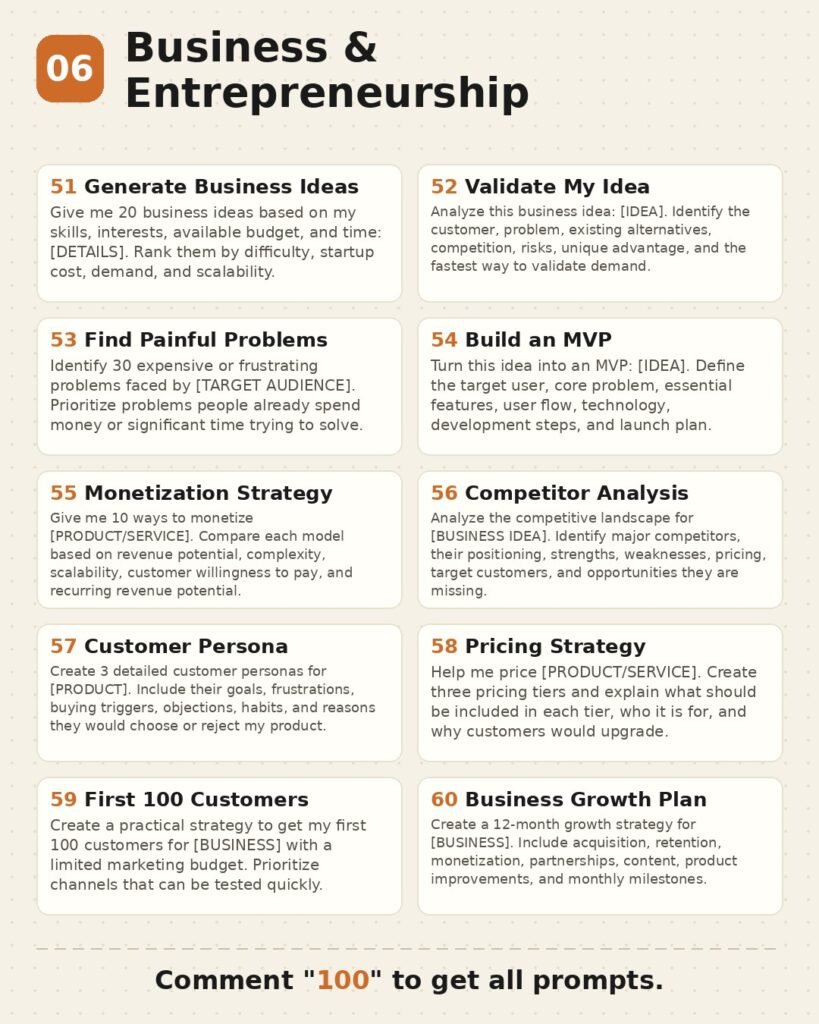
Business & Entrepreneurship
51. Generate Business Ideas — Give me 20 business ideas based on my skills, interests, available budget, and time: [DETAILS]. Rank them by difficulty, startup cost, demand, and scalability.
52. Validate My Idea — Analyze this business idea: [IDEA]. Identify the customer, problem, existing alternatives, competition, risks, unique advantage, and the fastest way to validate demand.
53. Find Painful Problems — Identify 30 expensive or frustrating problems faced by [TARGET AUDIENCE]. Prioritize problems people already spend money or significant time trying to solve.
54. Build an MVP — Turn this idea into an MVP: [IDEA]. Define the target user, core problem, essential features, user flow, technology, development steps, and launch plan.
55. Monetization Strategy — Give me 10 ways to monetize [PRODUCT/SERVICE]. Compare each model based on revenue potential, complexity, scalability, customer willingness to pay, and recurring revenue potential.
56. Competitor Analysis — Analyze the competitive landscape for [BUSINESS IDEA]. Identify major competitors, their positioning, strengths, weaknesses, pricing, target customers, and opportunities they are missing.
57. Customer Persona — Create 3 detailed customer personas for [PRODUCT]. Include their goals, frustrations, buying triggers, objections, habits, and reasons they would choose or reject my product.
58. Pricing Strategy — Help me price [PRODUCT/SERVICE]. Create three pricing tiers and explain what should be included in each tier, who it is for, and why customers would upgrade.
59. First 100 Customers — Create a practical strategy to get my first 100 customers for [BUSINESS] with a limited marketing budget. Prioritize channels that can be tested quickly.
60. Business Growth Plan — Create a 12-month growth strategy for [BUSINESS]. Include acquisition, retention, monetization, partnerships, content, product improvements, and monthly milestones.

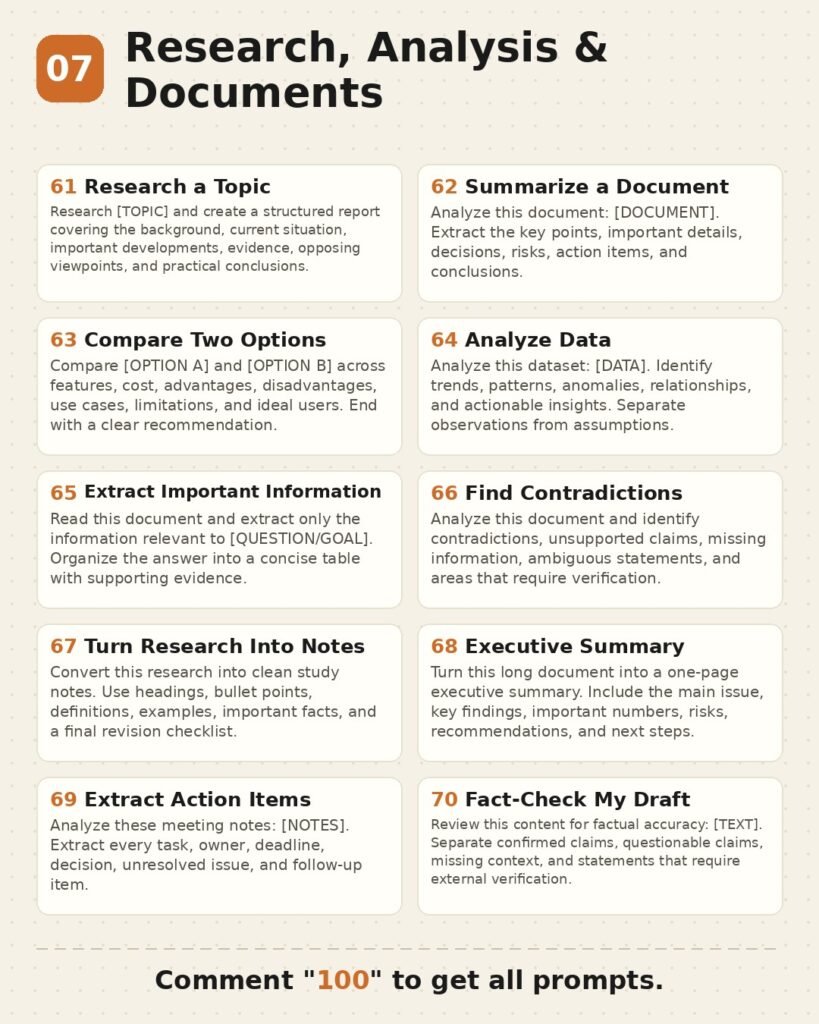
Research, Analysis & Documents
61. Research a Topic — Research [TOPIC] and create a structured report covering the background, current situation, important developments, evidence, opposing viewpoints, and practical conclusions.
62. Summarize a Document — Analyze this document: [DOCUMENT]. Extract the key points, important details, decisions, risks, action items, and conclusions.
63. Compare Two Options — Compare [OPTION A] and [OPTION B] across features, cost, advantages, disadvantages, use cases, limitations, and ideal users. End with a clear recommendation.
64. Analyze Data — Analyze this dataset: [DATA]. Identify trends, patterns, anomalies, relationships, and actionable insights. Separate observations from assumptions.
65. Extract Important Information — Read this document and extract only the information relevant to [QUESTION/GOAL]. Organize the answer into a concise table with supporting evidence.
66. Find Contradictions — Analyze this document and identify contradictions, unsupported claims, missing information, ambiguous statements, and areas that require verification.
67. Turn Research Into Notes — Convert this research into clean study notes. Use headings, bullet points, definitions, examples, important facts, and a final revision checklist.
68. Executive Summary — Turn this long document into a one-page executive summary. Include the main issue, key findings, important numbers, risks, recommendations, and next steps.
69. Extract Action Items — Analyze these meeting notes: [NOTES]. Extract every task, owner, deadline, decision, unresolved issue, and follow-up item.
70. Fact-Check My Draft — Review this content for factual accuracy: [TEXT]. Separate confirmed claims, questionable claims, missing context, and statements that require external verification.

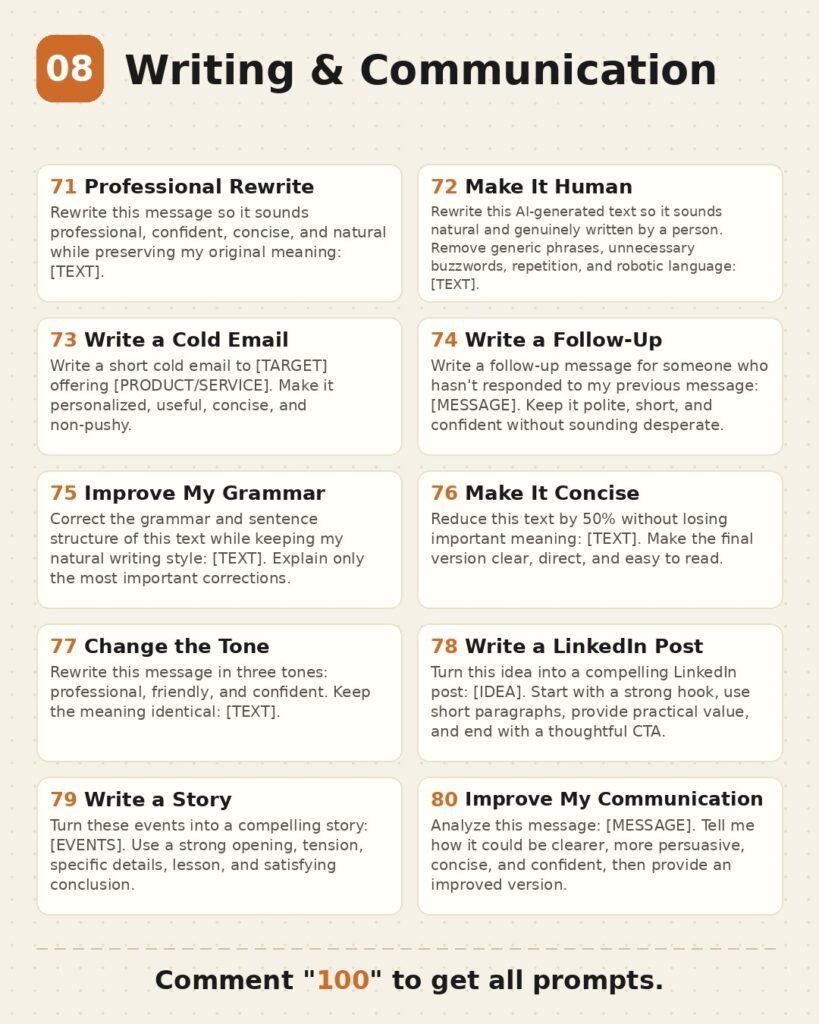
Writing & Communication
71. Professional Rewrite — Rewrite this message so it sounds professional, confident, concise, and natural while preserving my original meaning: [TEXT].
72. Make It Human — Rewrite this AI-generated text so it sounds natural and genuinely written by a person. Remove generic phrases, unnecessary buzzwords, repetition, and robotic language: [TEXT].
73. Write a Cold Email — Write a short cold email to [TARGET] offering [PRODUCT/SERVICE]. Make it personalized, useful, concise, and non-pushy.
74. Write a Follow-Up — Write a follow-up message for someone who hasn't responded to my previous message: [MESSAGE]. Keep it polite, short, and confident without sounding desperate.
75. Improve My Grammar — Correct the grammar and sentence structure of this text while keeping my natural writing style: [TEXT]. Explain only the most important corrections.
76. Make It Concise — Reduce this text by 50% without losing important meaning: [TEXT]. Make the final version clear, direct, and easy to read.
77. Change the Tone — Rewrite this message in three tones: professional, friendly, and confident. Keep the meaning identical: [TEXT].
78. Write a LinkedIn Post — Turn this idea into a compelling LinkedIn post: [IDEA]. Start with a strong hook, use short paragraphs, provide practical value, and end with a thoughtful CTA.
79. Write a Story — Turn these events into a compelling story: [EVENTS]. Use a strong opening, tension, specific details, lesson, and satisfying conclusion.
80. Improve My Communication — Analyze this message: [MESSAGE]. Tell me how it could be clearer, more persuasive, concise, and confident, then provide an improved version.

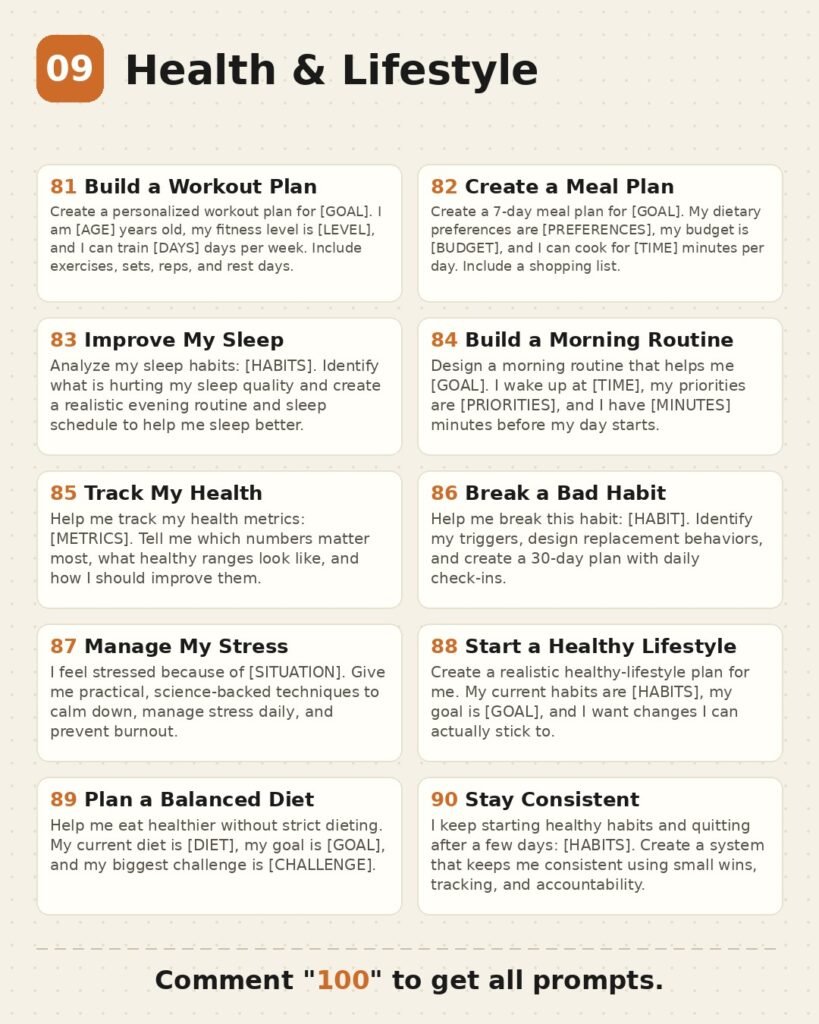
Health & Lifestyle
81. Build a Workout Plan — Create a personalized workout plan for [GOAL]. I am [AGE] years old, my fitness level is [LEVEL], and I can train [DAYS] days per week. Include exercises, sets, reps, and rest days.
82. Create a Meal Plan — Create a 7-day meal plan for [GOAL]. My dietary preferences are [PREFERENCES], my budget is [BUDGET], and I can cook for [TIME] minutes per day. Include a shopping list.
83. Improve My Sleep — Analyze my sleep habits: [HABITS]. Identify what is hurting my sleep quality and create a realistic evening routine and sleep schedule to help me sleep better.
84. Build a Morning Routine — Design a morning routine that helps me [GOAL]. I wake up at [TIME], my priorities are [PRIORITIES], and I have [MINUTES] minutes before my day starts.
85. Track My Health — Help me track my health metrics: [METRICS]. Tell me which numbers matter most, what healthy ranges look like, and how I should improve them.
86. Break a Bad Habit — Help me break this habit: [HABIT]. Identify my triggers, design replacement behaviors, and create a 30-day plan with daily check-ins.
87. Manage My Stress — I feel stressed because of [SITUATION]. Give me practical, science-backed techniques to calm down, manage stress daily, and prevent burnout.
88. Start a Healthy Lifestyle — Create a realistic healthy-lifestyle plan for me. My current habits are [HABITS], my goal is [GOAL], and I want changes I can actually stick to.
89. Plan a Balanced Diet — Help me eat healthier without strict dieting. My current diet is [DIET], my goal is [GOAL], and my biggest challenge is [CHALLENGE].
90. Stay Consistent — I keep starting healthy habits and quitting after a few days: [HABITS]. Create a system that keeps me consistent using small wins, tracking, and accountability.

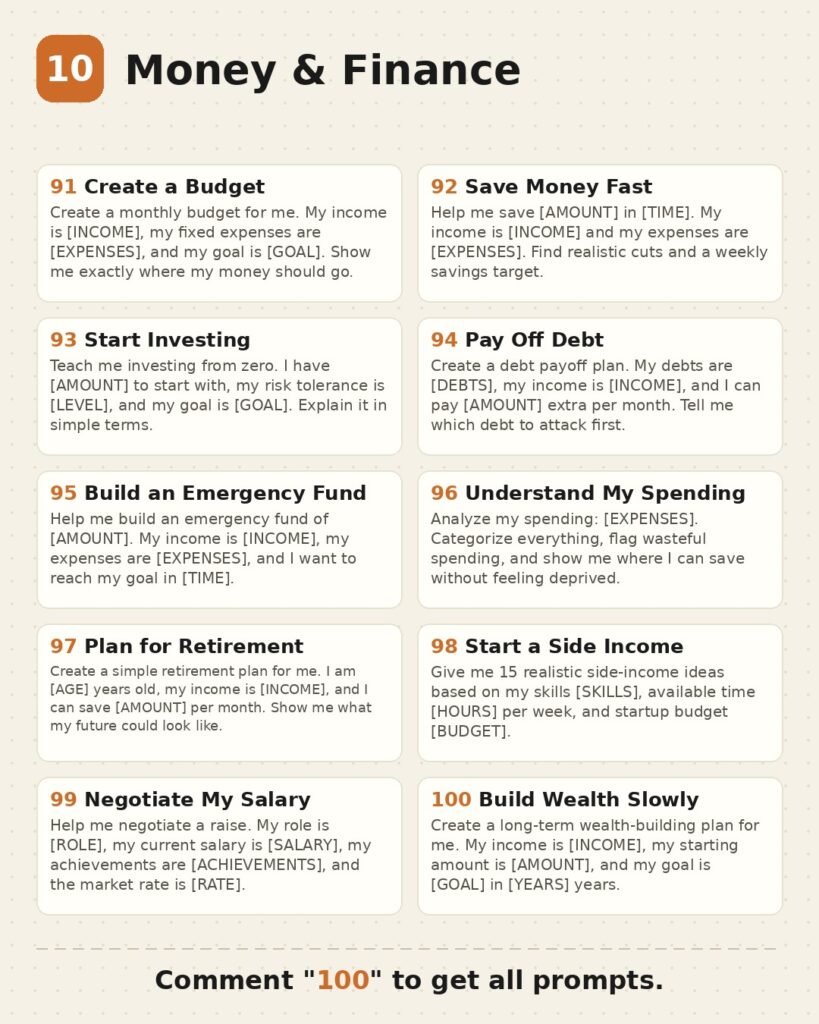
Money & Finance
91. Create a Budget — Create a monthly budget for me. My income is [INCOME], my fixed expenses are [EXPENSES], and my goal is [GOAL]. Show me exactly where my money should go.
92. Save Money Fast — Help me save [AMOUNT] in [TIME]. My income is [INCOME] and my expenses are [EXPENSES]. Find realistic cuts and a weekly savings target.
93. Start Investing — Teach me investing from zero. I have [AMOUNT] to start with, my risk tolerance is [LEVEL], and my goal is [GOAL]. Explain it in simple terms.
94. Pay Off Debt — Create a debt payoff plan. My debts are [DEBTS], my income is [INCOME], and I can pay [AMOUNT] extra per month. Tell me which debt to attack first.
95. Build an Emergency Fund — Help me build an emergency fund of [AMOUNT]. My income is [INCOME], my expenses are [EXPENSES], and I want to reach my goal in [TIME].
96. Understand My Spending — Analyze my spending: [EXPENSES]. Categorize everything, flag wasteful spending, and show me where I can save without feeling deprived.
97. Plan for Retirement — Create a simple retirement plan for me. I am [AGE] years old, my income is [INCOME], and I can save [AMOUNT] per month. Show me what my future could look like.
98. Start a Side Income — Give me 15 realistic side-income ideas based on my skills [SKILLS], available time [HOURS] per week, and startup budget [BUDGET].
99. Negotiate My Salary — Help me negotiate a raise. My role is [ROLE], my current salary is [SALARY], my achievements are [ACHIEVEMENTS], and the market rate is [RATE].
100. Build Wealth Slowly — Create a long-term wealth-building plan for me. My income is [INCOME], my starting amount is [AMOUNT], and my goal is [GOAL] in [YEARS] years.
How to Use This Prompt
- Copy the AI prompt from the prompt box above.
- Open Claude.
- Upload your reference photos if needed.
- Paste the copied prompt into the AI tool.
- Generate your result instantly.
Make it yours: Enhance this prompt or turn your result into a pin with the Pinterest Pin Maker.
This post brings together 100 ready-to-use Claude prompts in 10 practical sections — from learning and productivity to career, coding, content creation, business, research, writing, health and money. Every prompt is written to copy and paste directly into Claude: just fill in the [BRACKETS] with your own details and get a useful answer in seconds.
How to use it — Step 1: Pick a prompt from the list below that matches what you need. Step 2: Copy the full prompt text. Step 3: Paste it into Claude and replace everything in [BRACKETS] with your own details. Step 4: Send it and use Claude’s answer — ask follow-up questions if you want it refined further.
Want more? Browse all our Claude prompts — free and ready to copy.